Buying Guides
How to Sharpen a Chainsaw Chain the Right Way
A dull chain is the most common reason a customer walks into a repair shop convinced their saw is broken. It is not broken. It is blunt — and a blunt chain costs your customer time, fuel, and eventually a bar and a sprocket too. For distributors and repair shops, chain sharpening is more than a workshop chore: it is the conversation that turns a one-off chain sale into a repeat parts customer.
The cost of a dull chain
A sharp chain pulls itself through the wood and throws out long, clean chips. A dull chain makes fine powder, forces the operator to push, cuts crooked, and vibrates. Every one of those symptoms accelerates wear elsewhere. A chain that drags instead of cutting works the bar rails harder, heats the bar tip, and chews at the sprocket teeth. Shops see the pattern constantly: a customer replaces a chain, keeps the worn sprocket, and is back within weeks complaining the new chain is already ruined. It is not the chain. A worn sprocket destroys a new chain faster than hard wood ever will.
That is why the sharpening conversation matters at the counter. When a customer asks for a new chain, ask how the old one was cutting. If it was making dust, they may need a file, not a chain — and if the sprocket shows hooked or thinned teeth, they need both.
Get the file size right
There is no universal file. The correct round file diameter depends on the chain pitch, and it is printed on the chain packaging or in the saw manual. The common sizes are 5/32 inch, 3/16 inch, and 7/32 inch. Using a file that is too small leaves the cutting edge rounded and weak; one that is too large grinds away the tooth. Stock the three sizes and the matching file guide, and you remove the most common beginner mistake before it happens.
The technique: 30 degrees, even strokes, every tooth
Sharpening is a routine, not a talent. The steps are the same every time:
- Secure the saw. Clamp the bar in a vice or lock the chain brake so nothing moves.
- Work one side first. Mark the starting tooth with a marker so you know where the round ends.
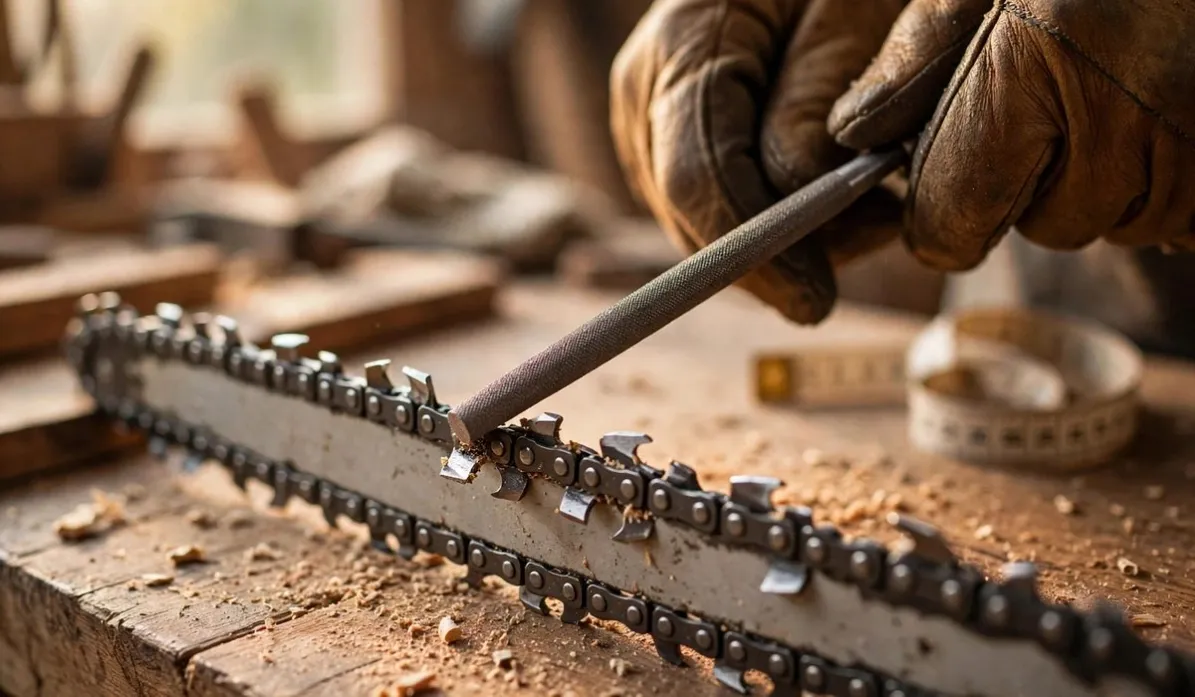
- Hold the file at 30 degrees to the bar, level, and push from the inside of the tooth outward. File on the push stroke only — lift on the return. Three to six strokes per tooth is usually enough.
- Give every tooth the same treatment. Count your strokes. If one tooth gets six strokes and the next gets three, the chain will cut in a curve.
- Flip the saw and repeat on the other side, keeping the same angle and stroke count.
- Check the depth gauges. After every three or four sharpenings, check the depth gauges (rakers) with a gauge tool and file them down to the recommended height. A chain with tall rakers will not bite, no matter how sharp the cutters are.
A chain that is properly sharpened feels different immediately: it feeds itself, the chips are thick, and the saw sounds unloaded. Teach a customer that feeling once, and they will come back for files, guides, and chains instead of a new saw.
Sharpen or replace?
A chain can be sharpened many times, but not forever. Replace it when the cutters are filed back to the wear marks, when teeth are cracked or missing, or when the chain has stretched beyond what the tensioner can take up. At that point, inspect the sprocket and the bar together. The rule repair shops pass on is simple: a new chain deserves a sprocket check. Pairing a fresh chain with a worn rim sprocket is the fastest way to shorten the new chain's life, and it is the easiest upsell to explain — the customer can see the wear with their own eyes.
Why parts quality decides the outcome
Sharpening technique only pays off if the parts underneath it are consistent. A sprocket that is slightly out of tolerance or a rim that wears unevenly will undo a perfect sharpening job. That is why we hold our sprockets, rims, and clutch drums to one standard, whether the order is a sample box or a full container — samples and bulk share the same production line and the same inspection. It is the same approach behind our oil pumps, where every unit is tested at operating speed with stable oil output before it leaves the factory. Distributors who stock parts that behave the same from the first box to the hundredth do not get the comeback complaints that eat margin.
A small service that builds loyalty
Offer a sharpening check with every chain sale. It takes five minutes, it shows the customer you know the trade, and it opens the honest conversation about the bar, the sprocket, and the chain as a matched set. Customers remember the shop that saved them a bar — and they come back when they need the next one.
Which models do your customers service most? Tell us — we will confirm the matching sprocket, rim, and chain combination for each one. Or browse the full range at https://www.zfmparts.com/products.